
Is Coral Casino Safe and UKGC Licensed?
 Available in GB
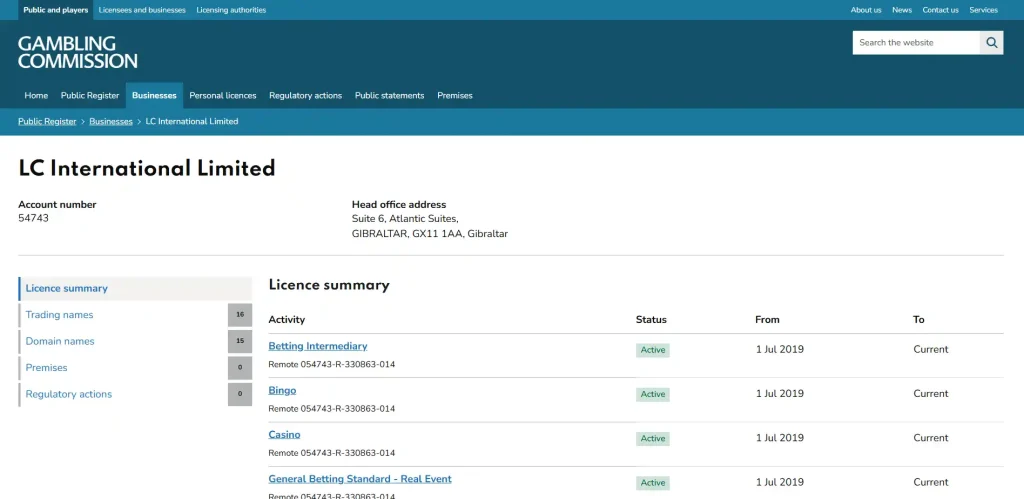
The UK Gambling Commission public register associates Coral with LC International Limited, account 54743.
Coral’s Great Britain regulatory status is directly verifiable in the UK Gambling Commission public register. The register lists LC International Limited under account 54743, shows an active Casino Remote licence and lists “coral” as an active trading name. The register also links coral.co.uk to that business record. Coral is part of Entain plc. Those facts establish the operator and licensing chain for Great Britain, but a licence is regulatory oversight, not a guarantee that a player will win, never experience a dispute or regard every game outcome as satisfactory.
The shortest evidence chain: Coral, LC International Limited, account 54743
The useful way to answer “is Coral licensed?” is to separate the consumer-facing brand from the licensed legal operator. In the UK Gambling Commission register, the business record is LC International Limited. Its account number is 54743. Within that record, “coral” appears as an active trading name, and the register search for coral.co.uk points to the same account.
The licence summary for account 54743 shows Casino Remote licence 054743-R-330863-014 as active. A remote casino operating licence is the UKGC permission relevant to offering casino games online to consumers in Great Britain. This is stronger evidence than a badge copied onto a review page because the chain can be checked in the regulator’s own register.
| Register field | Current verified value | Why it matters |
|---|---|---|
| Licensed business | LC International Limited | Identifies the legal operator behind the relevant account |
| UKGC account | 54743 | Gives a stable register reference |
| Casino Remote licence | 054743-R-330863-014, Active | Shows current remote casino permission in the register |
| Trading name | coral, Active | Connects the consumer brand to the licensed business |
| Domain match | coral.co.uk | Connects the reviewed website to the register record |
For the full account and product picture, see Coral Casino UK Review 2026.
How to read the UKGC register without confusing brand and operator
A common source of confusion is expecting the licence holder to be named exactly “Coral Casino”. The register structure separates the legal business from its trading names. LC International Limited is the business account holder, while Coral is one of the active trading names recorded under that account. The domain lookup provides another cross-check because coral.co.uk resolves to the same UKGC business record.
This distinction is also useful when reading terms, account messages or payment descriptors. A consumer can interact with the Coral brand while the underlying licensed entity is LC International Limited. The parent-group layer is different again: Coral is part of Entain plc, whose current corporate material lists Coral among its UK and Ireland brands.
Three names, three roles
Coral is the customer-facing trading name. LC International Limited is the UKGC account holder for the online activity covered here. Entain plc is the wider group that owns Coral. Treating those labels as interchangeable makes licence checks harder than they need to be.
What an active remote casino licence actually means
The UK Gambling Commission says businesses providing remote gambling to consumers in Great Britain need the relevant Commission licence. Its remote casino licence covers casino games offered through online services, including products such as roulette, blackjack and online slots. Coral’s account 54743 currently shows that remote casino activity as active.
For a player, the practical significance is that Coral’s Great Britain-facing online casino is operating within the UKGC licensing framework rather than relying only on a non-UK licence. The operator is subject to licence conditions and social responsibility codes that govern areas such as customer identity verification, underage protection and customer interaction.
This regulatory context is one reason the Coral KYC process exists. UKGC rules require remote operators to establish a customer’s identity before gambling is permitted, including at least name, address and date of birth. Coral’s own KYC material says age and identity verification is required and that additional documents can be requested when needed.
Regulation creates obligations, not a promise of outcomes
An active licence is meaningful evidence about who may lawfully provide the regulated service and which rulebook applies. It should not be stretched into claims the register does not make. UKGC licensing does not guarantee that an individual player will win, that every session will feel fair to the player, that no service problem can occur or that a complaint will always be resolved in the player’s preferred way.
The safer interpretation is narrower: the licence identifies a regulated operator and gives the Commission supervisory and enforcement powers under its framework. Players can then judge particular questions separately – for example, whether the game range suits them, whether a payment method is convenient, whether a bonus has acceptable terms, or whether account controls fit their needs.
For those product-specific questions, use the dedicated Coral casino games, Coral casino payment methods and Coral casino bonus guides rather than treating the licence as a quality score.
Identity and underage controls are part of the licence framework
UKGC Licence Condition 17.1.1 requires remote licensees to obtain and verify information establishing a customer’s identity before that customer is allowed to gamble. The required information includes name, address and date of birth. Separate social responsibility rules require age verification before a remote customer can deposit, access free-to-play gambling games or gamble using money, a free bet or a bonus.
These controls explain why account verification is not optional friction added solely at withdrawal. The Commission also states that a withdrawal request should not create a new demand for information that could reasonably have been requested earlier, although information can still be sought later where another legal obligation requires it.
Coral’s own verification page follows the same basic model: checks start for new accounts, are often automated, and can lead to additional document requests. Detailed document examples belong on the KYC page, so this trust page keeps the focus on what the regulatory requirement signifies.
Safer-gambling controls you can verify on Coral
Coral currently provides account controls including deposit limits, time-outs, self-exclusion and reality checks. A deposit limit sets a ceiling on how much money can be added over a chosen period. Reality checks provide an elapsed-time reminder during play. Time-out is a temporary break, while self-exclusion is designed for a longer period away from gambling.
These tools are relevant to a licence review because social responsibility is part of the regulated framework, but their existence should not be presented as proof that gambling is risk-free. They are controls that a player can use to shape access, spending and time. Coral’s current safer-gambling material also explains that limit decreases take effect immediately while increases require a delay before becoming active.
UK rules additionally require financial vulnerability checks when relevant thresholds are reached. The purpose is to identify indicators of potential financial vulnerability and require proportionate action where risk is identified. This is a regulatory control, not a statement about any particular customer’s finances.
Advertising and player-protection rules sit outside the game lobby
The regulatory picture is broader than the casino interface. UK advertising rules prohibit gambling ads that are likely to be of strong appeal to under-18s. That matters because compliance obligations cover how regulated gambling is marketed as well as how accounts are opened and managed.
For a player comparing operators, the useful distinction is between a brand claim and a regulator rule. Coral can describe its own products and tools, but whether the operator is licensed should be checked in the UKGC register. Likewise, a promotional message does not override age, identity, safer-gambling or advertising requirements imposed by the regulatory framework.
What Entain ownership adds to the evidence chain
Entain’s current corporate site lists Coral among its brands and describes Coral as having a UK high-street and online presence. That establishes the parent-group relationship without changing the identity of the UKGC licensee for the online Coral activity covered here. In other words, ownership and licensing answer different questions.
Ownership tells you which wider corporate group the brand belongs to. The UKGC record tells you which legal entity holds the relevant gambling permissions. Keeping those facts separate helps avoid a common misconception where a large parent company’s reputation is treated as if it were the licence itself.
A practical five-step Coral licence check
- Open the UK Gambling Commission public register rather than relying on a review badge.
- Search for Coral or coral.co.uk and identify the matching LC International Limited record.
- Confirm account number 54743.
- Open the licence summary and verify that Casino Remote status is active.
- Open the trading-names section and confirm that “coral” is listed as active.
This method is reproducible. It also makes future checks easier because if a trading name, operator or licence status changes, the public register is the place that should show the change.
Does a Coral win attract UK gambling tax?
For ordinary UK customers, gambling winnings are generally tax-free, while gambling duties are levied on operators. This is a concise tax point rather than a full tax-law analysis, and different treatment can apply where gambling forms part of a wider business or other unusual arrangement.
What Coral’s UKGC licence does – and does not – tell a UK player
LC International Limited holds UKGC account 54743, the account has an active Casino Remote licence, ‘coral’ is listed as an active trading name and coral.co.uk is associated with that business record.
Those facts establish the regulated operator and the framework that applies in Great Britain, but they do not guarantee individual gambling outcomes or make every product feature equally suitable for every user. Game choice, payment compatibility, promotion terms, account controls and personal limits remain separate decisions.
The most useful trust check is therefore evidence-led: verify the operator in the public register, then evaluate the specific Coral features you actually plan to use.